Docs/Settings/Compute

Compute

Minerva can run Python code cells right inside your notes. The Compute tab does one thing: it lets you choose which Python on your computer does that work. If you're happy with the Python Minerva already finds, you never need to open this tab. To learn how to write and run code cells, see Code & compute cells.

Choosing your Python

By default, Minerva looks for Python on your computer automatically. If you'd rather point it at a specific one — say, a setup you've prepared with the packages you use — you can name it here. Your choice applies to every thoughtbase you open on this computer.
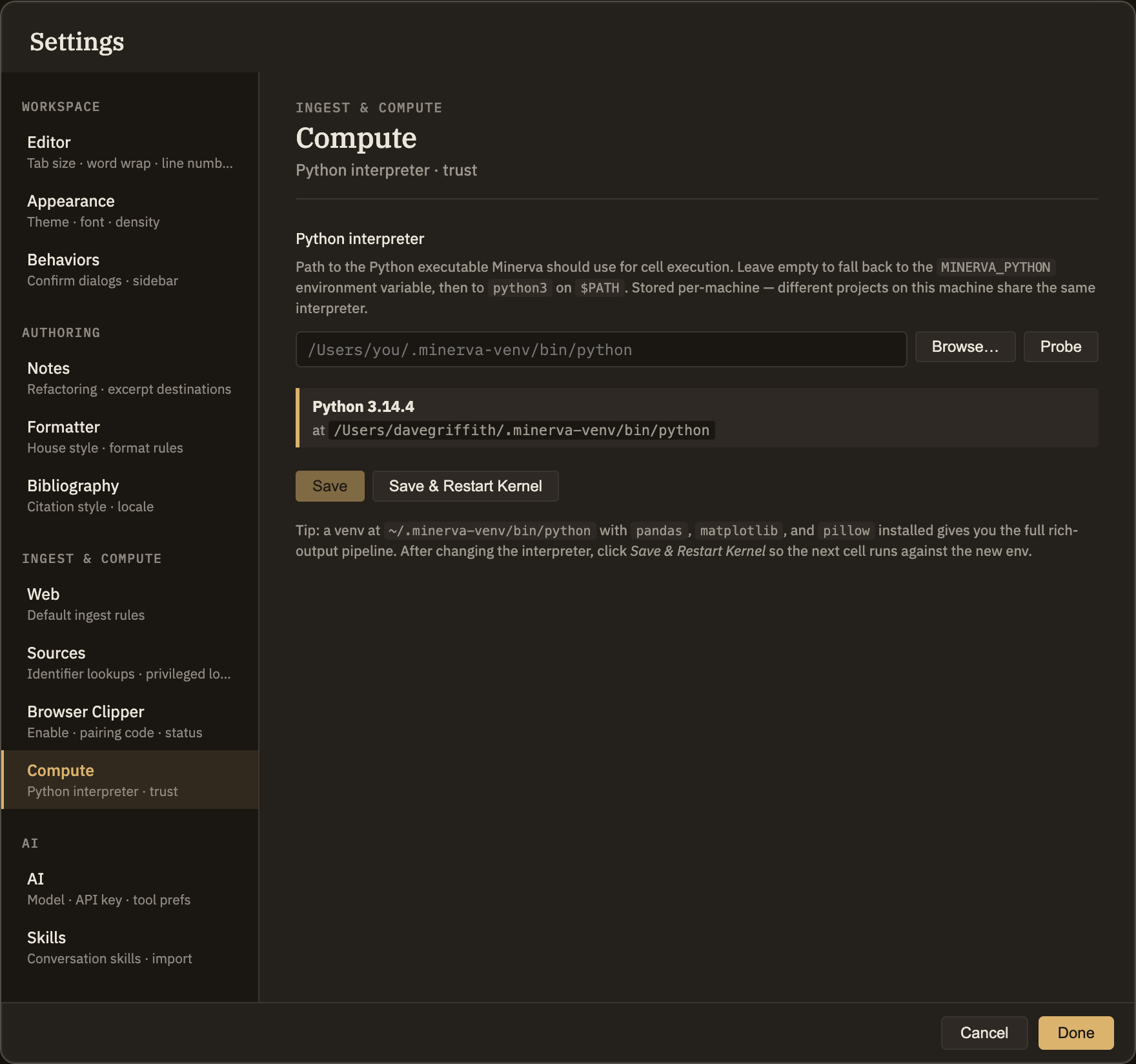
Python location
Where your chosen Python lives. Leave it empty to let Minerva find one for you.
Browse…
Pick your Python from a file chooser instead of typing its location. Minerva checks it right away so you know it works.
Check
Test the current choice without saving it. Minerva tells you which version it found, or explains what went wrong if it couldn't run it.
Save
Keep your choice. Available once you've made a change.
Save & restart
Save your choice and switch to it straight away, so your next code cell uses it. Anything earlier cells had set up — variables, imported packages — starts fresh, just as if you'd reopened Minerva.
Clear
Forget your saved choice and let Minerva find a Python for you again. Appears only after you've saved one.
The Compute panel: a field naming which Python to use with Browse and Check beside it, a line beneath confirming the version that was found, and the Save, Save & restart, and Clear buttons below.
Screenshot — the Compute tab
Running code is your call

Minerva won't run Python in a thoughtbase until you say it's okay. The first time you run a code cell there, it asks for a quick confirmation, then remembers your answer for the rest of that thoughtbase. That's a one-time prompt at the moment you run a cell, not a switch on this tab. For the full picture, see Code & compute cells.