Docs/Viewing options/Split panes & windows

Split panes & windows

Sometimes you want to see two notes at once — a source next to the claim it supports, or an outline next to the section you're drafting. Minerva gives you two ways to do that: split the current window into side-by-side panes, each with its own tabs and view mode, or open a separate window.

Splitting into panes

A pane is a section of the window with its own tabs and its own view. You can split any pane into two, and split again from there, arranging your notes into as many side-by-side and stacked panes as you like. Drag the divider between two panes to resize them.

Split right
\ (Ctrl\ on Windows/Linux), the split button in a pane's toolbar, or View → Split Editor Right. Adds a new pane to the right of the current one.
Split down
\ (CtrlShift\), the split-down button, or View → Split Editor Down. Stacks a new pane below the current one.
Drag a tab to an edge
Drag a tab toward the left, right, top, or bottom edge of a pane; a preview shows where it'll land. Dropping there splits the pane and moves the tab into the new one.
Move between panes
/ (CtrlAlt), or View → Focus Next/Previous Group, moves your focus from one pane to the next.
Close a pane
W or View → Close Group closes the focused pane and gives its space back to the panes beside it.

Moving notes between panes

With more than one pane open, you can move a tab from one to another in two ways:

Drag it over
Drag a tab and drop it in the middle of another pane, or onto its tab bar, to move it there without creating a new split.
Move to Other Group
Right-click a tab and choose Move to Other Group. When several panes are open, this becomes a short list so you can pick where it goes.

A note can only be open in one pane at a time. If you try to open something that's already open elsewhere, Minerva simply brings that pane into focus.

Each pane keeps its own view

Each pane remembers its own view mode — Source, Preview, or Editor + Preview — so you can, for example, edit a note in one pane while reading its finished form in another. A new pane starts in the same mode as the one it split from, but you can change either one at any time.
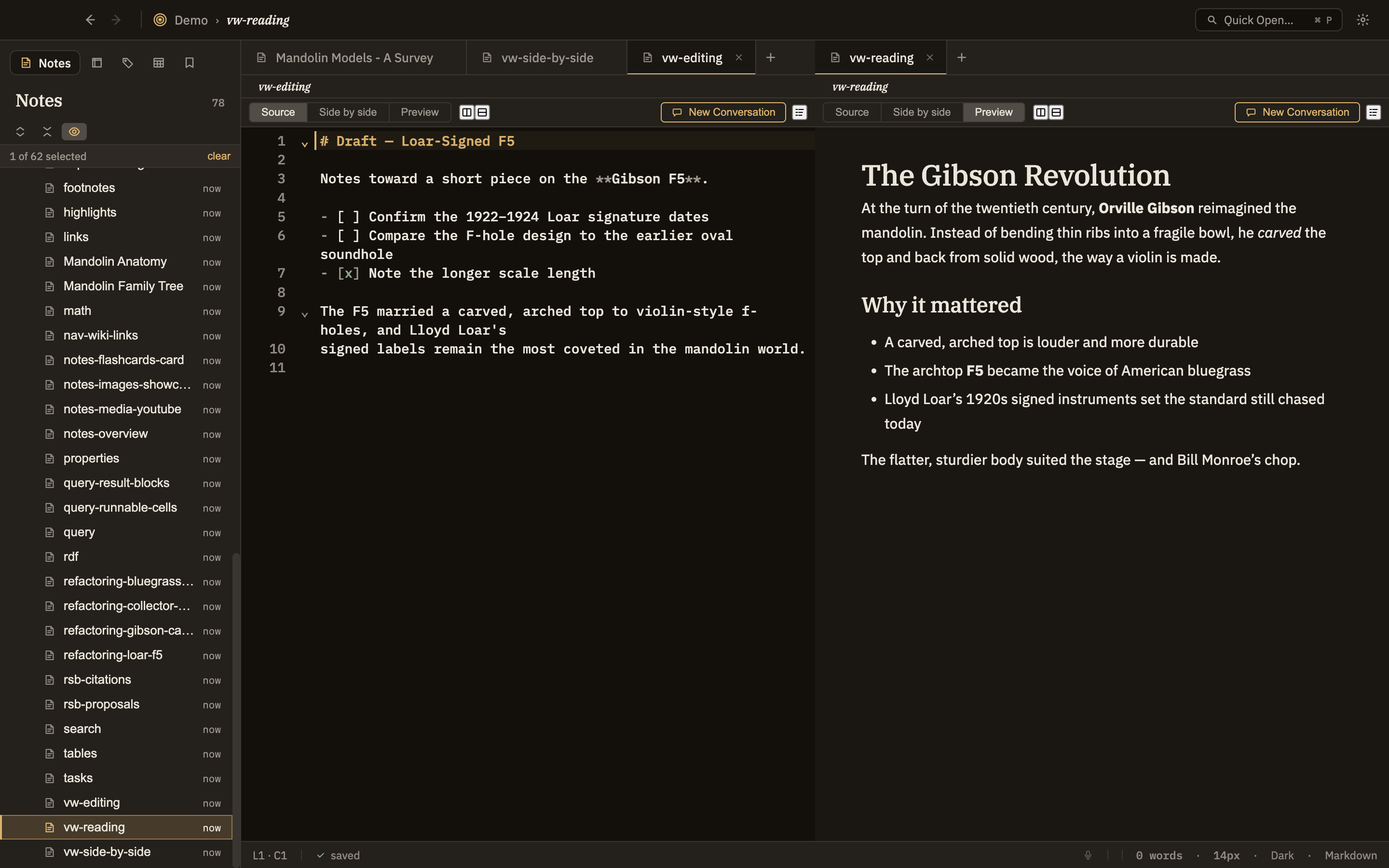
The window is split into two side-by-side panes. The left pane shows a note you're editing; the right pane shows a different note fully rendered for reading. Each pane has its own tabs and toolbar.
Two panes, two views

Opening a new window

File → New Window (N) opens a fresh, empty Minerva window. You then open a thoughtbase into it, either the same one you already have open or a different one entirely. Changes you save in one window show up in the other automatically.

Split pane or new window?

Both let you see two things at once — here's how to choose:

Use a split
You want two views side by side on one screen within the same thoughtbase — a source next to the note citing it, or the same note being edited and read at once.
Use a new window
You want a second window you can move and resize on its own — handy across two monitors — or you want two different thoughtbases open at the same time.