Your living notebook

Your Living Notebook for
Thinking, Learning, and Building with AI.

A place where the work you do with AI lands and stays — growing, connecting, and computing as you go. We call it a thoughtbase: not a folder of dead files, but a living map of what you know, where every note you add makes the whole thing richer.

Free and open source · Local-first · Your notes are plain files you own
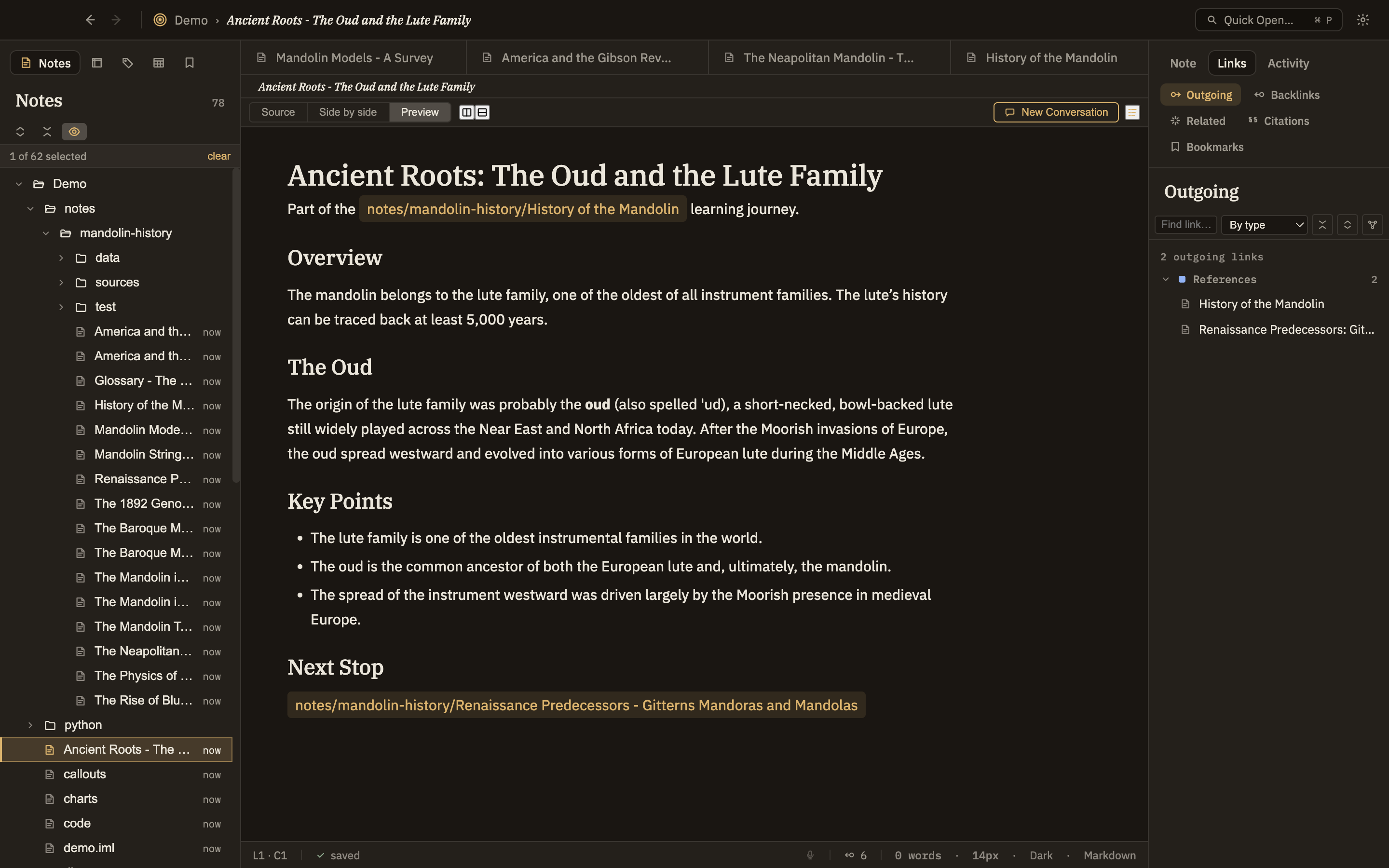
The app in its best light: a thoughtbase open, a note in split view, the AI proposing a change in the review panel. Dark theme. This is the single most important image on the site — it should make someone think "I want to be in that window."
Hero

The problem

You've had brilliant conversations with AI.
Where did they go?

Somewhere in your chat history is a genuinely good idea you worked out with an AI three weeks ago. You can't find it. It wasn't sourced, it didn't connect to anything, and the next conversation started from zero. The most powerful thinking tool ever built has no memory of your thinking — and no way to hold it.

Minerva is the place that work goes instead. Not another chat window: a workspace where every insight becomes a note you can keep, link, check, and build on — for years, not until you close the tab.

What makes it different

Three things no chat window gives you

🔒

You stay in control

The AI proposes; you confirm. Nothing it generates touches your notes until you approve it — and Minerva can prove nothing ever skipped your review. Its suggestions are evidence to weigh, never edits made behind your back.

🕸️

It gets richer as it grows

Your notes link, cite, support, and contradict each other. The AI reads that structure to answer from what you actually wrote — so the more you build, the more there is for it to draw on, and the more grounded every answer becomes.

📂

It's yours, permanently

Your thoughtbase is plain files on your own disk. No account, no server, no lock-in. Export to Markdown, HTML, PDF, or RDF anytime. If Minerva vanished tomorrow, your thinking would still open in any text editor.

The compounding effect

The more you write,
the more it has to work with.

A chat window starts every conversation from nothing. A living notebook starts from everything you already know. Each note you add is another node in your knowledge graph — another claim the AI can cite, another source it can check against, another connection it can follow.

A thoughtbase with a thousand linked, sourced notes isn't just a bigger pile of text. It's a richer map — and the AI is answering from your map, not from its guesses. The work you put in doesn't just accumulate. It compounds.

And it isn't only Minerva's AI that benefits. Your thoughtbase speaks MCP — so the coding agent in your terminal, the assistant in your browser, whatever you're using next year, can all query the same body of knowledge. Your notes stop being one app's data and start being context for everything.

  • It answers from your notes — grounded in what you actually wrote, with citations back to the exact ones.
  • Structure is what it reads — your links, tags, claims, and sources are the context, not a wall of undifferentiated text.
  • Nothing gets left behind — a thought from eight months ago is as reachable as one from this morning.
  • Your other AI tools can read it too — Minerva speaks MCP, so the agents you already use can query your thoughtbase and answer from what you actually know.
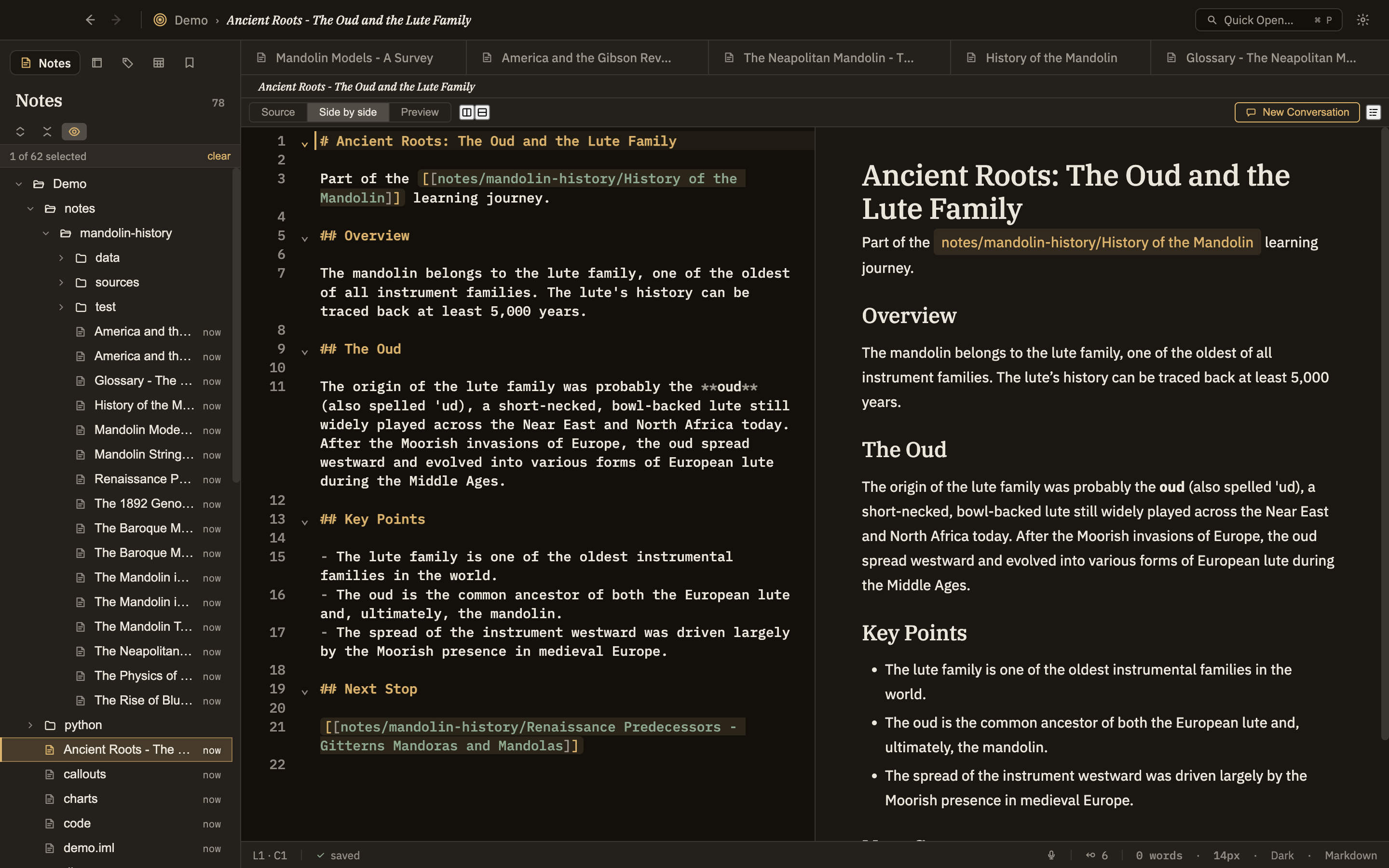
A mature thoughtbase: many notes, dense links, and the AI answering a question with citations pointing back into that web. The image should convey <em>accumulated knowledge being used</em>, not an empty starter file.
A thoughtbase with depth

The core principle

The AI proposes. You decide.

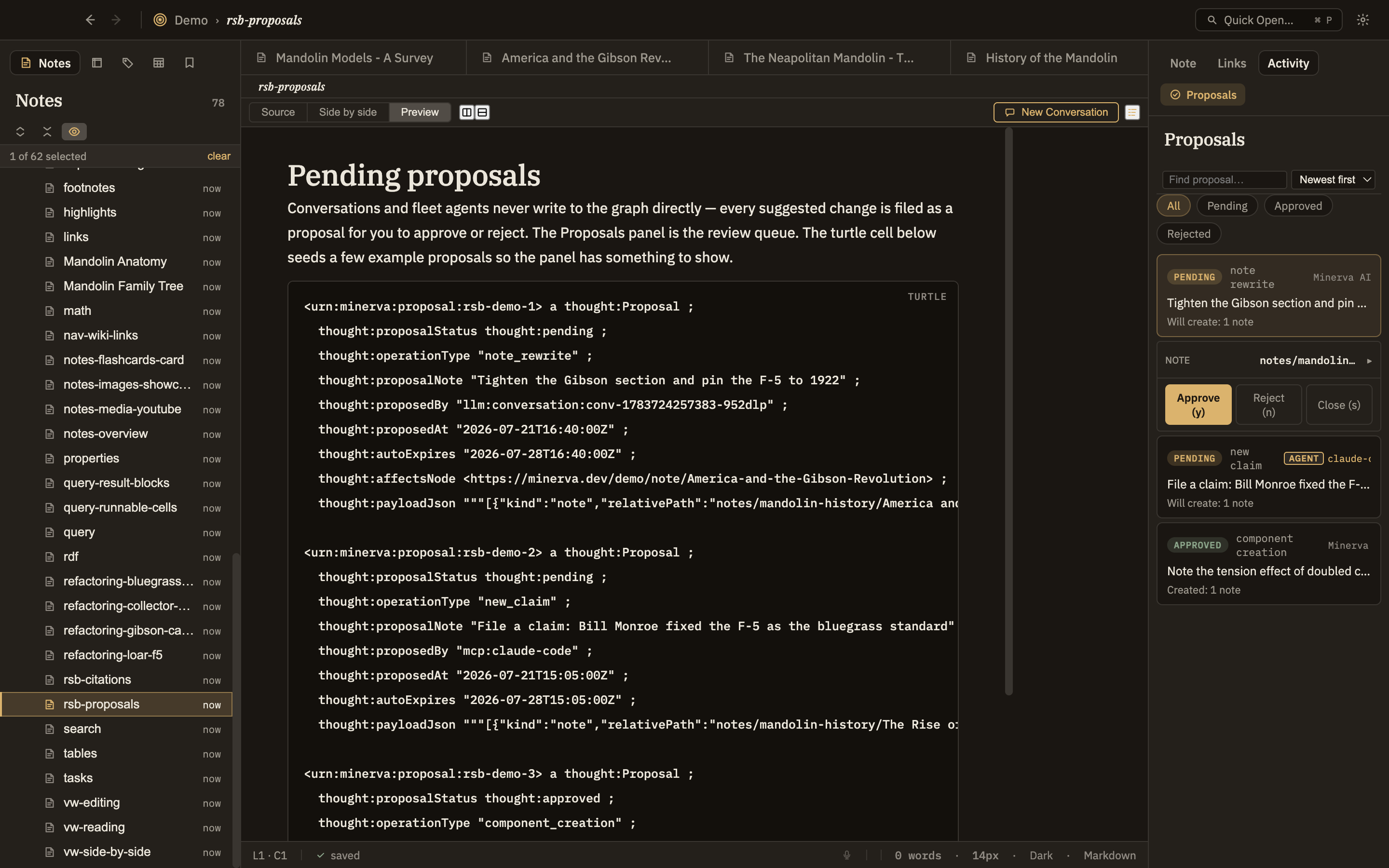
Most AI tools change your work and hope you noticed. Minerva inverts that. Every claim, edit, tag, or source the AI produces arrives as a proposal — reviewed side by side, accepted with a keystroke, or ignored until it expires. What you know stays what you chose to know.

  • See exactly what would change, before it does.
  • You set which changes need sign-off and which can apply quietly.
  • A built-in integrity check can prove the AI never wrote around you.
The side-by-side proposal review: a pending AI suggestion with approve / reject, so the "you decide" principle is visible, not just claimed.
Proposal review

Not a weekend experiment

Built to be depended on

There's a fair question about any new tool from a small maker: will it still be here in a year? Minerva's answer isn't a promise — it's the architecture. Because your notes are plain files and everything exports to open standards, your thinking doesn't depend on Minerva's future at all. The tool is built so it can never strand you, and it's open source, so it can outlive any one person's attention.

Start your living notebook.

Give the work you do with AI somewhere to live — structured, sourced, and yours to keep. It only gets better from here.

Free · Open source · Local-first